 Illustrative
Curodont Early Cavity Repair
Planned opening 2027. We are not yet treating patients. These guides are educational; availability and treatment details require confirmation.
An educational overview of clinician-applied treatment for selected early cavities; the intended U.S. product requires confirmation.
Early decay can involve mineral loss before a hole forms. This guide does not provide product-specific instructions: the exact U.S. Curodont product intended for Whole Tooth has not been confirmed.
 Illustrative
What it is, and why you might discuss it
- Early decay may be present before a hole forms. An examination helps distinguish active lesions from stable changes.
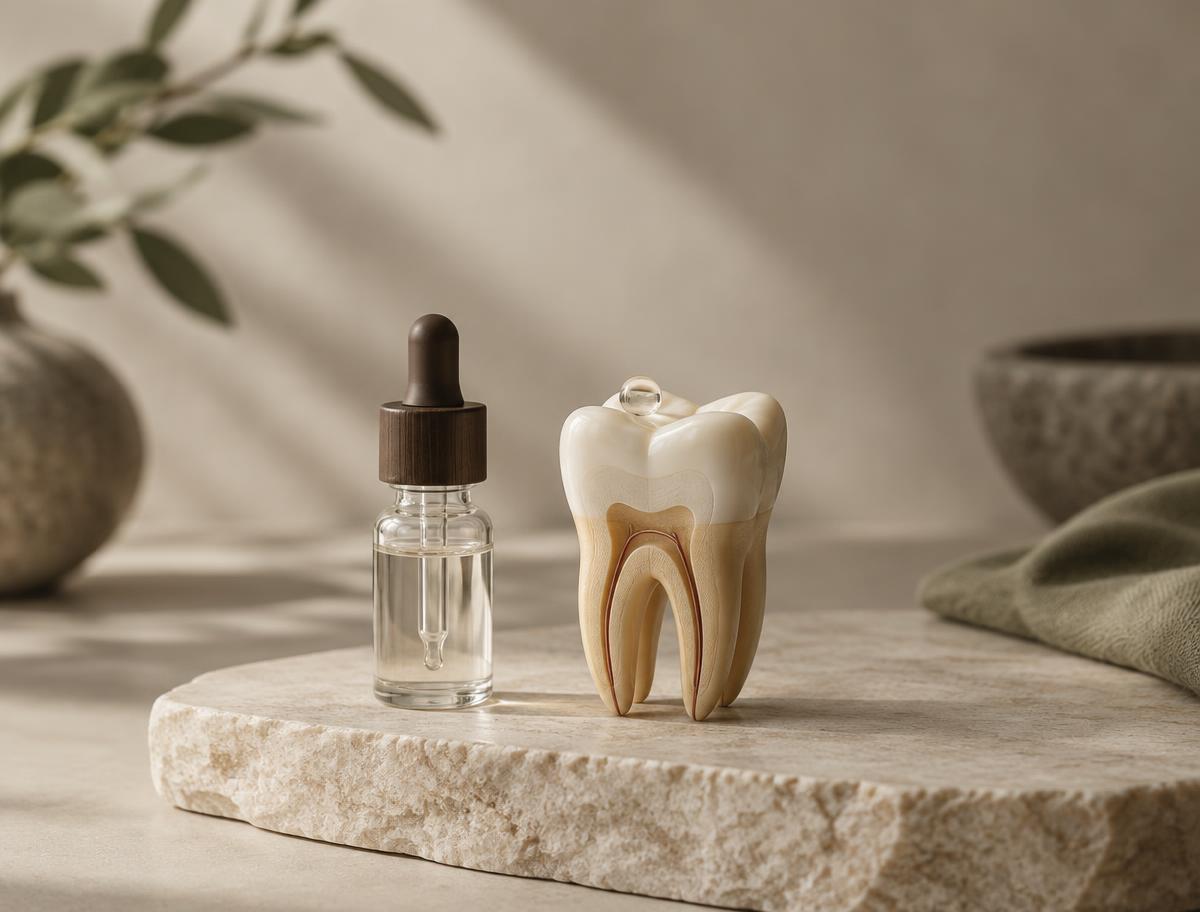
- Curodont Repair is a low-viscosity liquid containing a self-assembling peptide — a short protein chain developed by vVARDIS in Switzerland. Painted onto the lesion, it flows into the porous enamel and assembles into a temporary scaffold inside it.
- On that scaffold, calcium and phosphate ions already present in your saliva are encouraged to form new hydroxyapatite — the mineral enamel is made of. Over the following weeks and months the weakened area can harden again. vVARDIS calls this process Guided Enamel Regeneration.
- Curodont products are not interchangeable. The U.S. manufacturer lists Curodont Repair Fluoride Plus, which contains fluoride; the product intended for Whole Tooth requires confirmation.
How we assess whether it suits you
- The lesion has to be early: still within the enamel, with no cavity an instrument can catch in. An examination and X-rays — sometimes with a digital scan — identify which areas qualify.
- An area that has already cavitated, or where decay has reached the dentine, needs different treatment, usually a bonded filling or a ceramic inlay or onlay.
- Your overall cavity risk matters as much as the individual spot. Treating one area does not protect the rest of the mouth, so the routine behind it is reviewed at the same time.
- It can be applied by a dentist or a dental hygienist, and is suitable for children as well as adults.
What the process involves
- 01A dentist assesses the lesion and cavity risk before deciding on an approach.
- 02The exact product, preparation and application instructions must be verified by the treating clinician.
- 03Follow-up checks whether the lesion remains stable or needs further care.
Alternatives worth asking about
- Professional hygiene visits
Removes the biofilm that feeds the process, which is the part you can control.
- A bonded filling
The correct option once a surface has actually broken down into a cavity.
- Monitor with shorter review intervals
Reasonable where a lesion is judged stable and your risk is low — provided the review genuinely happens.
Benefits
- No drilling, no needle and no anesthetic, so the tooth structure is left untouched.
- May form part of a nonrestorative approach for a suitable early lesion.
- Quick enough to add to a normal appointment.
- Product suitability and precautions must be checked for the individual patient.
- Can be repeated if new early spots form.
Risks
- A lesion can be deeper than it looks; an area treated today may still need a filling later.
- It does nothing for the rest of the mouth — new early spots can form wherever biofilm and sugar are present.
- It is not suitable where the surface has already broken down.
- As with any mineral-based approach, the outcome depends on the saliva and habits around it, and cannot be promised for a specific tooth.
Limitations
- Only for early, non-cavitated lesions — it cannot rebuild a tooth that already has a hole.
- Cannot be used to treat a tooth that is already painful or infected.
- No treatment guarantees an individual result; lesions require ongoing review.
- It does not replace brushing, diet changes, hygiene visits or regular check-ups.
- Availability and suitability are confirmed at your examination.
Timing
A few minutes in the chair, normally as a single application. Whether a repeat would help is decided at your next review rather than on the day.
Recovery
Follow the treating clinician’s written instructions for the exact product used. Product-specific eating, drinking, rinsing and brushing instructions are not provided here pending verification.
What affects the cost
These factors explain the scope of care, not a Whole Tooth price quote. Assessment fees are separate from later treatment estimates. Whole Tooth’s fees and disclosure policy require confirmation; ask about applicable assessment charges before arranging a visit.
- Number and extent of eligible early lesions.
- Assessment, records and follow-up included in the proposed care.
Questions people ask
References
Sources for background information; not a record of clinical approval or individualized instructions.
Related guides
- Read the guide
Hygiene & Professional Cleaning
Remove plaque, hardened deposits and surface stain with cleaning paced around your comfort and practical support for home care.
- Read the guide
Comprehensive Exam
Understand your teeth, gums, bite and jaw health through a thorough examination, clear records and a conversation about priorities.
- Read the guide
Tooth-Colored Fillings
Repair a small or moderate cavity with shade-matched composite resin, carefully bonded and shaped to fit your tooth and bite.
- Read the guide
Ceramic Inlays & Onlays
Restore a larger damaged area with bonded ceramic when a filling is not enough and the tooth does not need full crown coverage.